

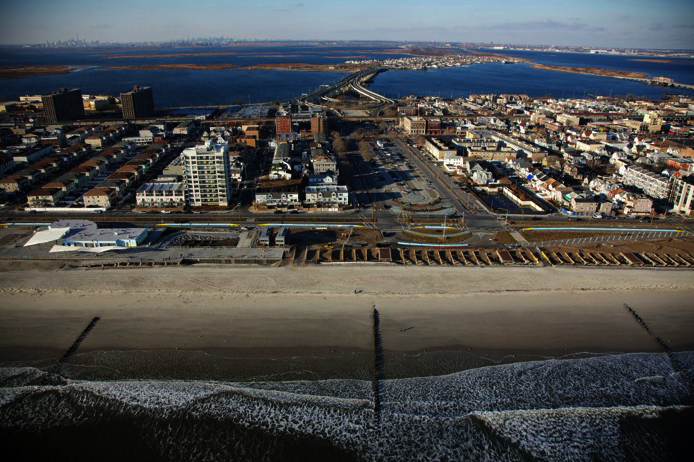
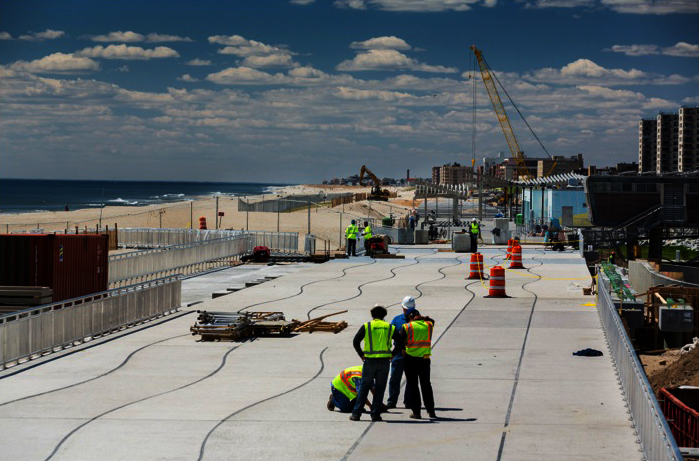
In October of 2012, Hurricane Sandy hit the Eastem Seaboard of the United States, destroying thousands of businesses, homes, public amenities and regional infrastructure, including the iconic Rockaway Boardwalk in Queens, New York, a peninsula known for attracting surfers and beachcombers from around the world. The New York City Economic Development Corporation and the City’s Department of Parks and Recreation, working with the Army Corps of Engineers, commissioned a team to reimagine the approximately five miles of beachfront with a resilient, creative vision. Construction began on the $341 million project in May of 2014 and the project advanced with the goal of meeting stringent design criteria (including replacing the formerly wooden structure with concrete) while producing a high-quality boardwalk that could be rapidly constructed and opened to the public in stages beginning in the summer of 2015.
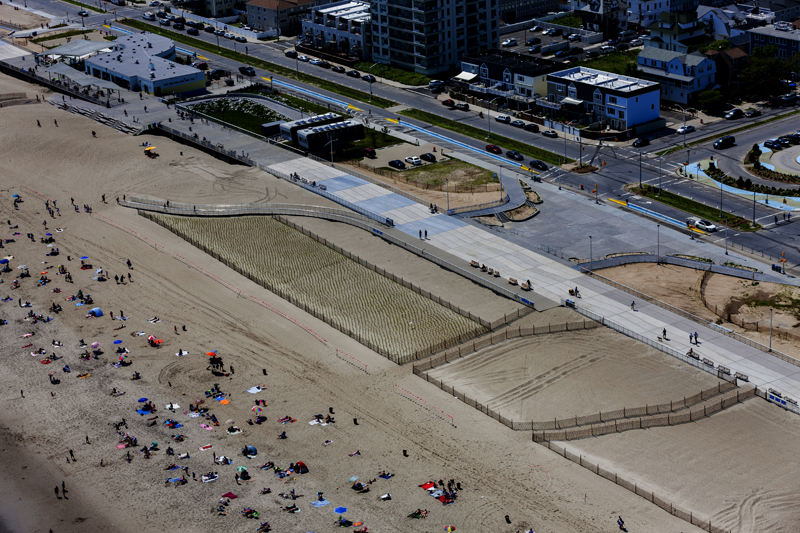
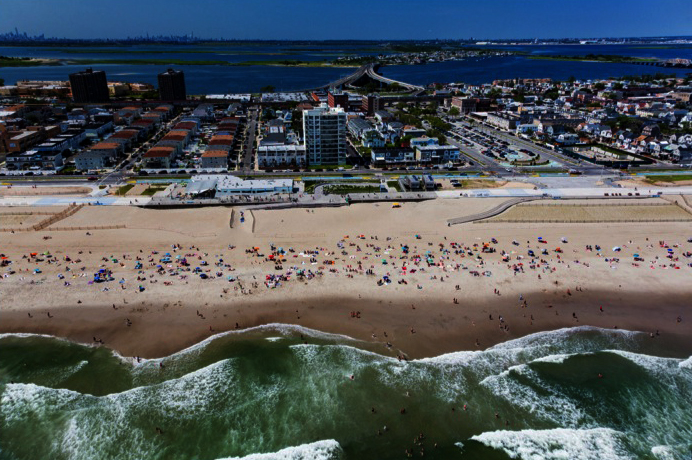
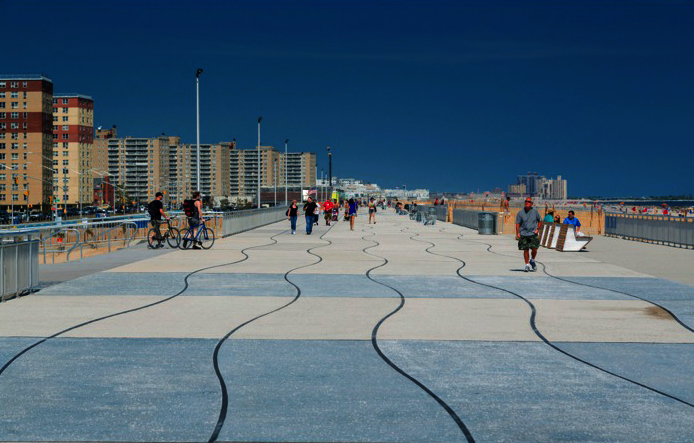
Through an extensive public outreach process, the residents of the Rockaways made clear that their landmark - their “Main Street” - should be retumed to its former greatness as a destination. The new boardwalk is decked with light blue and sand colored concrete planks undulating to mimic the ocean waves that lie to its south. This iconic deck design has struck a chord with the community devastated by Superstorm Sandy. Designated bike lanes and a multitude of curved, ADA-compliant ramps allow patrons physical and visual access to the waterfront along the approximately 5 mile boardwalk.
The Rockaways has a rich history as a recreational destination. The pre-Sandy boardwalk attracted millions of New Yorkers for the summer season each year. The local communities played a central role in the planning and design of the Boardwalk. Seven Public Community Engagement Workshops were held to inform the communities along the boardwalk and to assess their priorities. Out of this extensive community planning effort, a cohesive vision for the boardwalk emerged, featuring playgrounds, skate parks, performance spaces, tailored to the beach environment. The final plan for a new elevated boardwalk was unveiled in 2014, and the first two sections were open to the public in 2015.
The new boardwalk is once again a pedestrian main street, a waterfront amenity, and a major recreational destination where residents from all of the different communities along the shore mixed and mingled. The approximate 5 mile stretch serves as the tie that unites all the different neighborhoods that lie on the Rockaway Peninsula. The materials, details, and graphics of the boardwalk are designed to highlight the neighborhood‘s identity and compliment the natural beach environment.
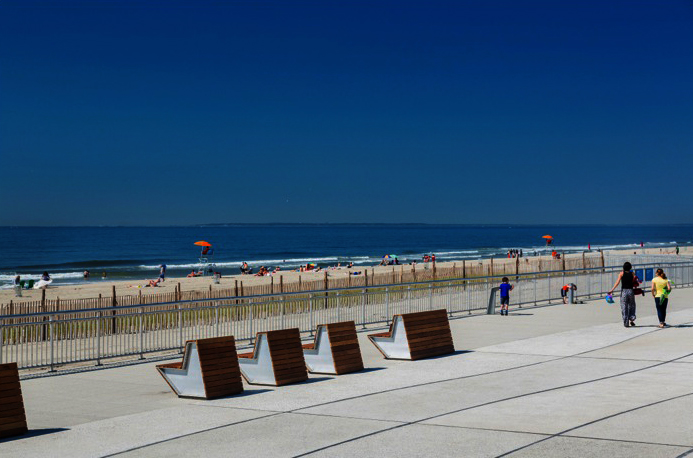
The boardwalk includes new, publicly-initiated design features including City Lights by architect Thomas Phifer. Custom fumishings are made with salvaged wood from the former boardwalk and beach access structures are decked with recycled plastic lumber, an homage to the historical wooden boardwalk. The most dramatic feature of the new boardwalk is quite literally the community’s signature spelled out in 30 foot high letters using blue planks as pixels to spell out “ROCKAWAYS” over a 4,000 foot length of boardwalk - easily read from the airplanes flying in and out of the nearby John F. Kennedy Airport.
The reconstruction of the boardwalk was key for the sustained economic development of the peninsula. The City of New York put a high priority on reconstructing and improving the boardwalk to help the community recover and to increase the overall attractiveness and value of the area to residents, visitors, and investors. Residents are moving back, businesses and shops are being restored and reopening, and commercial and residential buildings are being erected. People come by subway, bus, and bike to surf, swim, stroll, and enjoy local food. The boardwalk has become a thriving public open space amenity.
This project uniquely combines resiliency and recreation through several design concepts for a better protected and more active peninsula. The Rockaway Boardwalks design incorporates hard and soft measures to ensure its longevity and resiliency, supporting a more sustainable and forward-thinking form of coastal development and reconstruction. The boardwalk is elevated 3 feet above the FEMA 100-year floodplain and made of steel-reinforced concrete planks fastened to steel support piles. The existing Army Corps sand dunes were extended to stretch under the boardwalk and were replenished, stabilized, and planted. These efforts will greatly reduce the risks and effects of extreme weather, storm surge, and climate change.
The project required detailed numerical coastal modeling, coordination with the US Army Corps of Engineers (USACE) storm risk reduction efforts, augmentation of the USACE berm with vegetated berms, compliance with New York State Department of Environment requirements, close interaction with the community and the New York City Public Design Commission (PDC), extensive community outreach, an increased attention to aesthetics, and an innovative structural design. The aggressive design and construction schedule was achieved in part through a highly modularized design that relied on readily available structural shapes combined with precast concrete pile caps, deck planks and sand retailing wall panels that could be fabricated offsite under controlled conditions.
The new boardwalk, will be the longest and largest resiliency project completed to date by the City of New York. It is also the first new, large-scale boardwalk built in the New York City area since the Robert Moses era.
Even by New York standards, the jury thought this $420-million project is “amazing.” The iconic Rockaway Boardwalk was battered by Hurricane Sandy in 2012. City agencies working with the Army Corps of Engineers resolved to rebuild the five-mile long walkway with the aim of reopening by the summer of 2015. The key decision was to replace the wooden walkway with concrete planks variously light blue and sand-colored. There are designate bike lanes and multiple handicapped ramps. Called for in community workshops were playgrounds, performance spaces and skate parks.
The new boardwalk is at once a pedestrian main street, linking together the varied Rockaway Peninsula communities. It is at once a major waterfront amenity and a recreational destination serving all of the varied communities of the area. A notable feature is custom furnishings made from wood salvaged from the former boardwalk. The most dramatic feature is the spelling out of the community signature “Rockaways” in 30-foot high letters stretching over 4,000 feet – clearly visibile from planes using nearby Kennedy Airport.
The reconstruction has stimulated an economic resurgence. Residents are moving back, business and shops have recovered and new commercial and residential buildings have been erected. The boardwalk incorporates forward-thinking features. The boardwalk is three feet above the 100-year floodplain and is made of steel-reinforced concrete planks fasted to steel support piles for longevity. Sand dunes were replenished and stabilized and were allowed to stretch under the boardwalk.
Visitation reaches 4.17 million annually. Completion is scheduled for 2017.