Urban Waterfront Manifesto
© 1999 The Waterfront Center.
This document may not be reproduced without express permission from The
Waterfront Center.
Dear colleagues:
To promote sensitive, site-specific urban waterfront planning and development
that reflects the individuality of each place, we, together with associates,
have developed a set of principles to suggest to communities. When done right,
we're saying, waterfront redevelopment projects can be exciting and
transforming.
We issue our statement to counter the unfortunate tendency by some in the design
and development fields given to what we term formula approaches — copying
something that has worked in one place and transferring it elsewhere, or
building projects unsympathetic to their unique waterfront setting. There are
also cases of over-building and excessive privatization along urban waterfronts
today.
The Urban Waterfront Manifesto has been endorsed
already by a number of our associates. If
you want to add your name to the list, please let us know.
Urban Waterfront Manifesto
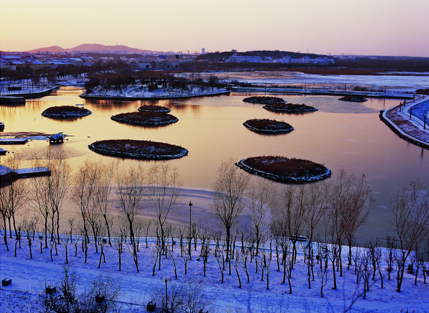
Beach Restoration Qinhuangdao City, China
Water is a defining force that fundamentally shapes the character of each place
it touches. The role of water in transport, industry, sanitation and nourishment
made it the raison d'être of human settlement. It is a feature to be honored
and celebrated — not to be treated merely as cosmetic or as just a commodity.
Waterfronts, the unique places where land and water meet, are
a finite resource embodying the special history and character of each community.
Urban waterfronts, like the cities they help define, are dynamic places. The
last three decades have witnessed profound changes along abandoned or underused
waterfronts. The trend is accelerating in cities around the globe. It applies to
canals, lakes and rivers as well as coasts.
With this growing popularity comes a tendency by some to look
for the quick solution, to adopt a formula that may have worked somewhere else.
In the 1980's it was the "festival marketplace" fad. In the 1990's, it
is the "urban entertainment district" and/or stadiums. In a time of
pervading sameness and homogenization worldwide this is particularly dismaying
because waterfronts above all factors give each community a chance to express
its individuality and help distinguish it from others.
We, the undersigned, urge careful consideration of the
following principles. They are offered in the spirit of encouraging communities
to aim for distinctiveness as they undertake the challenge of converting or
conserving their waterfront resources.
It is essential to keep in mind the inherent public interest in waterfronts, reflected in public ownership of water itself.
Planning
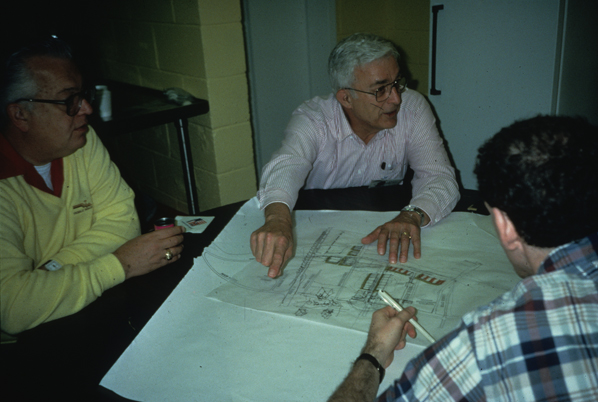
Planning in Yorktown Virginia
Waterfront planning should be long-range, comprehensive and holistic and should encompass all relevant disciplines. It should use all appropriate technologies and encourage a system of sustainable growth and operation.
Meaningful community involvement is integral to valid waterfront planning and development. It should begin early and be continuous.
Waterfront work is not just about economic development, is not simply a design question or only about environmental issues. Rather it is a fusion of these and related disciplines that should be sought.
We encourage communities to think long-term in waterfront work. Many conversions take 10, 15 or 25 years. The understandable desire to achieve instant results should be resisted in all except the smallest steps. Development over time allows a richness of character vs. the sameness of a one-time "Big Bang" approach.
It should be remembered that every waterfront is an integral part of a watershed consisting of creeks, rivers, estuaries or bays.
Development
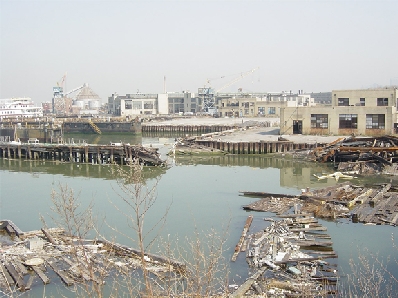
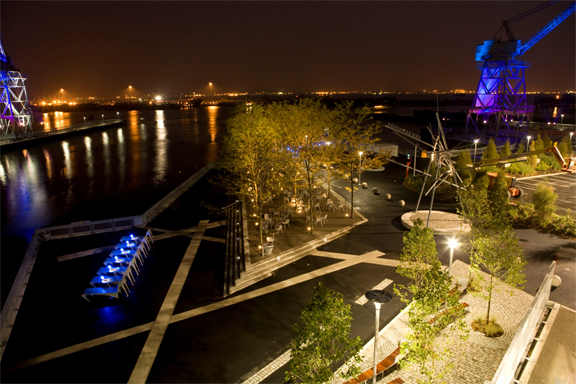
Erie Basin Before and After
The best undertakings involve a partnership between the dynamism of the private sector, the stewardship of public entities and the energy of citizens.
Public access to and along the urban waterfront should be the hallmark of all projects, including residential developments. This means physical and psychologically welcoming access. Visual access to the water likewise should be a pervading objective.
It is vital that communities distinguish between learning from good examples of waterfront planning and development elsewhere and blindly copying them. Waterfront concepts and projects should flow from the nature of each place and embody its essential spirit.
Where possible, a diversity of uses wants to be included along waterfronts, from passive parks to vibrant commercial attractions. People of all income levels and cultures should feel welcome. Nighttime activities as well as daytime can be provided. Distinctive places for children as well as the elderly should be included.
Waterfronts present unparalleled opportunities for interpretation and education — of natural values, community history and culture, including notably the industrial and transportation activities that often preceded today's developments. Preserving and interpreting the tangible aspects of the history of a place provides character and meaning to waterfront development.
The tendency to clean up waterfronts should be approached carefully so that rich underlying values are not unnecessarily sacrificed. Preferences for uses that require access to water is important, even if they are somewhat unsightly.
Public
art installations should be encouraged and the active participation of each
city's arts community sought from the outset of waterfront planning, to
ensure that artists' special way of seeing things is incorporated.
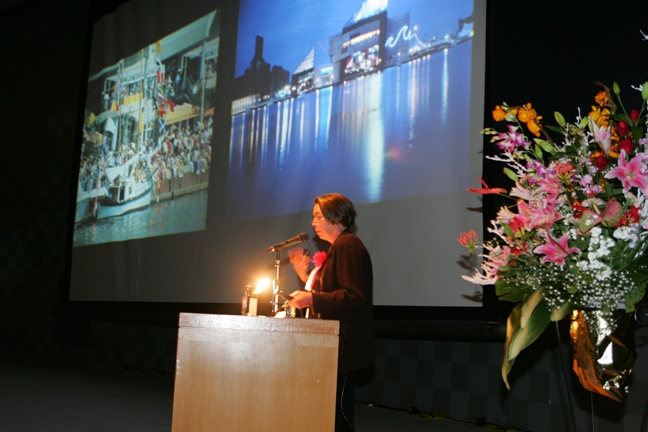
Ann Breen, Co-Director of the Waterfront Center
Prepared
July 10, 1999
Cape May, New Jersey, USA
Signatories:
·
Ed Astone, Town Manager,
·
Crystal Barriscale, Beyer Blinder Belle,
·
David Benn, Cho Wilks and Benn,
·
Geraldine M. Bolanowski, Councilwoman,
·
Ken Boshcoff, Mayor of
·
Ronald R. Bourne, Bourne Consulting Engineering,
·
Jim Bowen,
·
Ann Breen, The
·
Peter Brink, National Trust for Historic Preservation,
·
Ann Buttenwieser,
·
Deborah Carey, Friends
of the Fort Point Channel,
·
Kenneth W. Carruth, Township of
·
Erik Carson, Executive Dept., State Planning Office,
·
Kenneth M. Cobb, JJR Incorporated,
·
Rodney A. Cobi, Ctr. for Landscape Interpretation, Port
·
Arthur Collins Sr., Collins Enterprises, Old
·
Marianne Connolly, MA, Water Resources Authority,
·
Douglas Coolman, EDSA,
·
Stuart Dawson, Sasaki Associates, Inc.,
·
Steve Durrant, Alta
Planning and Design,
·
Tony Edwards, EDCO Design Ltd.
·
Jan Eversen, Glenn & Sadler Engineers and Architects,
·
R. Allen Eskew, Eskew+,
·
Nicholas Falk, Urban and Economic Development Group,
·
Karen Fiene, Karen Fiene Architects ,
·
David Fisher, British Waterways, Watford
·
Jennifer Fleming, Pensacola Com. Redev. Agency,
·
Ed Freer, JJR Incorporated,
·
Raymond Gastil, Van Alen Institute,
·
H. Linwood Gilbert, Urban Economics Inc.,
·
Rick Gonzalez, REG Arcitects,
·
James Guerra, James Guerra Architects,
·
Karl T. Haglund, New
·
Stephen Hallquist,
·
Bonnie A. Harken, Harken Architects & H.L.W. Strategies,
NY
·
Barry Hersh,
·
Erik Hess, City of
·
Nick Hollo, Keys Young, Milsons Point, NSW,
·
Alan Horwitz, The Hillier Group,
·
Grant Jones, Jones & Jones,
·
Barbara Kauffman, Regional Business Authority,
·
Michael W. Keller,
·
Kevin Kilduff,
·
L. Michael Krieger Esq., Port Authority of New York & New
Jersey (retired),
·
Douglas Lemle, Lemle Associates Inc.,
·
Mark London,
·
Jeanne Lukenda, Carol R. Johnson Associates,
·
Patty Lundeen, WETDesign,
·
Larry T. Manuel,
·
Ian McAskile, Maglin Furniture Systems Ltd.,
·
Prof. Dorn McGrath,
·
Patricia Merrell, Chickasaw Bluffs Conservancy,
·
·
Joe Moseley, Shiner Moseley and Associates Inc., Corpus
Christ, TX
·
Mary Ellen Murphy,
·
Bill Neyenhouse, NJDEP, Coastal Plan & Prog.,
·
Beth Nicholson, Save the Harbor/Save the Bay,
·
Carole Nixon,
·
Charles Norris, Norris and Norris Associates,
·
Thomas M. Norton, New York State Canal Corp.,
·
Anne Olson,
·
Chris Oshikata,
·
Slobodon Dan Paich, The Artship Foundation,
·
William C. Payne,
·
Janice Penner, The Forks North Portage Partnership,
·
Melvin Ramos,
·
John Randolph, Schuylkill Development Council,
·
Dick Rigby, The
·
Fabian Rivera, Keyspan Energy,
·
Thomas H. Robertson,
·
Monty Robson,
·
Harriet B. Saperstein, Consultant,
·
Joseph Schachter, Concrete Flotation Systems, Inc. (retired),
·
Capt. Bill Sheehan, Hackensack Riverkeeper Inc.,
·
John R. Sherwood, The Sherwood Consultancy,
·
Carol Sondheimer, Dept. of Economic Development,
·
Scott J. Spota, J.C. MacElroy Company, Inc.,
·
Michael L. Stark, President, Shawnee Run Greenway, Inc,
·
Robin Stein,
·
David Stones, The Forks North Portage Partnership,
·
Greg Swanzey, The Schooner Ernestina Com.,
·
Prof. Athena Tacha,
·
Gail Thomas, The Dallas Institute,
·
Sandra Threlfall, Waterfront Coalition,
·
Aaron J. Tuley, Ctr. for Landscape Interpretation, Port
·
Fred Were, Waterfront Dev. Corp., Ltd,
·
Rick Wiederhorn,
·
Paul Willen,
·
Marilyn Williams, The Forks North Portage Partnership,
·
Helen Wilson, Conservation Heritage Design,
·
Kathy Wine, River Action, Inc.,
·
Colin
·
Arthur Ziegler Jr.,
·
Susan Zusy, RTKL Associates Inc.,
Want to
add your name to the growing number? E-mail us at mail@waterfrontcenter.org.
e-mail:
mail@waterfrontcenter.org ©
2007 The Waterfront Center
Content and photographs on this site may not be reproduced without express
permission from The Waterfront Center.